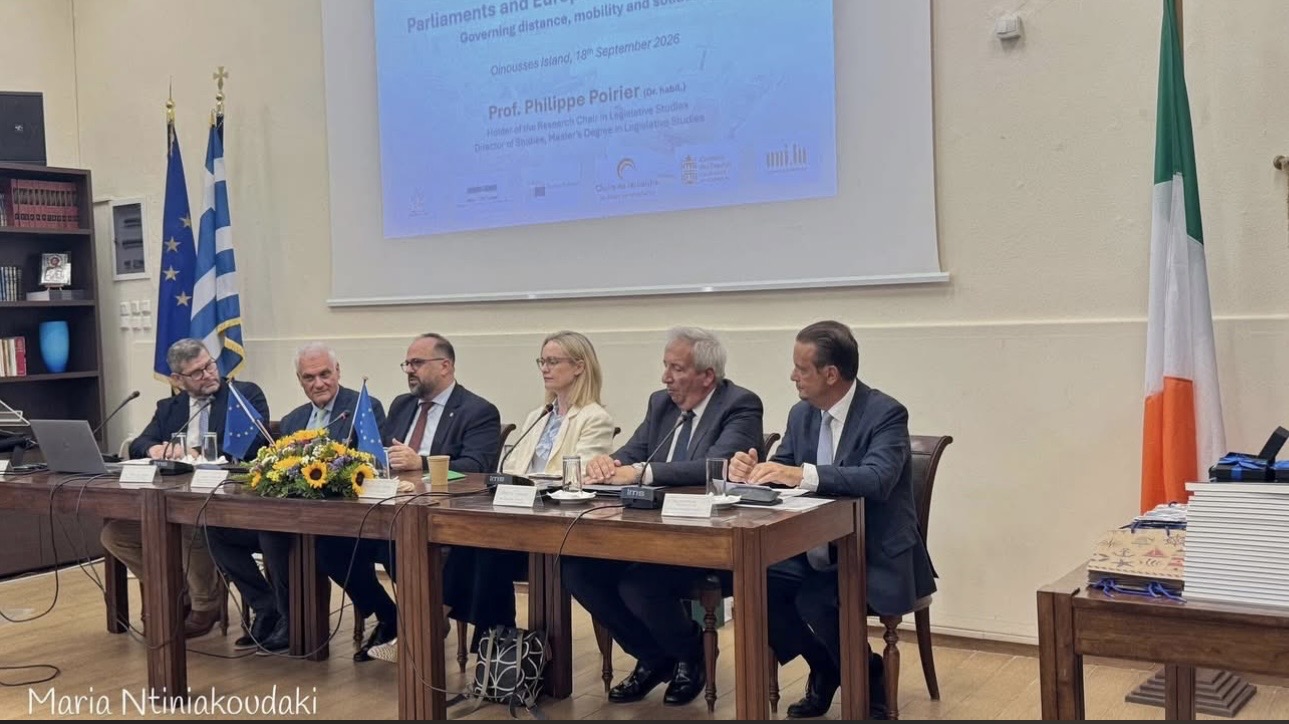
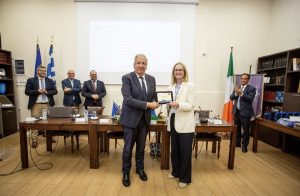
Σημαντική συνάντηση πραγματοποιήθηκε στις 18 Σεπτεμβρίου στις Οινούσσες, με αφορμή την Ιρλανδική Προεδρία του Συμβουλίου της Ευρωπαϊκής Ένωσης, με επίκεντρο τη νησιωτικότητα και τον ρόλο των ευρωπαϊκών νησιών στην ευρωπαϊκή ολοκλήρωση.
Στη συνάντηση συμμετείχε ο Επικεφαλής του Europe Direct Βορείου Αιγαίου, Καθηγητής Παναγιώτης Γρηγορίου, ο οποίος ανέπτυξε την ακαδημαϊκή διάσταση του θέματος με ομιλία με τίτλο «University, Insularity and European Construction».
Στην παρέμβασή του αναφέρθηκε στις ιδιαίτερες προκλήσεις που αντιμετωπίζουν τα ευρωπαϊκά νησιά, αλλά και στις δυνατότητές τους να αποτελέσουν σημαντικό μέρος της ευρωπαϊκής ολοκλήρωσης και της πολιτικής συνοχής. Ιδιαίτερη αναφορά έκανε στον ρόλο του Πανεπιστημίου Αιγαίου, στη λειτουργία του Europe Direct Βορείου Αιγαίου και στη δημιουργία του εργαστηριακού παραρτήματός του στις Οινούσσες.
Παράλληλα, τόνισε τη σημασία της ευρωπαϊκής πολιτικής για τη νησιωτικότητα και της αξιοποίησης των ευρωπαϊκών χρηματοδοτικών εργαλείων για την αντιμετώπιση των ιδιαίτερων προκλήσεων των νησιωτικών περιοχών.
Οι Οινούσσες, όπως σημείωσε, αποτελούν χαρακτηριστικό παράδειγμα μιας νησιωτικής κοινωνίας με έντονο ευρωπαϊκό προσανατολισμό, αναδεικνύοντας στην πράξη ότι η ευρωπαϊκή συνοχή μπορεί να φτάνει έως και τα πιο απομακρυσμένα όρια του ευρωπαϊκού χώρου.
Παρατίθεται ακολούθως το πλήρες κείμενο της ομιλίας του Επικεφαλής του Europe Direct Βορείου Αιγαίου, Καθηγητή Παναγιώτη Γρηγορίου, με τίτλο “University, Insularity and European Construction”, όπως εκφωνήθηκε στο πλαίσιο της συνάντησης στις Οινούσσες.
University, Insularity and European Construction
Panos Grigoriou, Professor of EU & International Law, Holder of European Chair Jean Monnet
Your excellencies,
Ladies and Gentlemen,
I would like to thank the Secretary General for Shipping and Ports Mr. Manolis Koutoulakis, the Irish Presidency of the Council of the EU and the Mayor of Oinousses, Mr. George Daniil for their trust in our academic work focused on the political, institutional, constitutional and legal aspects of the European Project but also in our commitment to civic engagement within the broader European context.
On 1 July this year, one island State, an EU Member State, was succeeded by another island State, also an EU Member State. Ireland took over from Cyprus as holder of the Presidency of the Council of the EU.
Through this succession of events, for the first time in the history of European integration, we are formalising an initial form of pact between the European Union and the European islands, in June 2026.
For far too long, the European islands have been overlooked in the process of European integration.
Higher education institutions located on European islands face significant geographical constraints (isolation, transport costs, dependence on the mainland), but they are increasingly organising themselves into strategic academic networks to turn these challenges into ecological, economic and scientific strengths.
At the University of the Aegean, spread across six Aegean islands we know very well all these specificities of this region, the Jules Verne’s Archipelago.
Under no circumstances is our research approach to identify insularity as the weak point of European integration. Quite the contrary: we consider it to be a distinctive feature of the European project and a fundamental challenge for the cohesion of the European area.
We think and act beyond national borders to take informed decisions in a changing Europe and in a globalised world. We realised very early on that we had to adopt a European approach, which must never be confined to our region. Since the creation of our first Jean Monnet European Academic Chair in 2002, we have made the European project fundamental point to our academic strategy.
We work to use the interdisciplinary results developed to help to make European objectives stable and dynamic for the future. We are thinking economically, legally and politically together, combining activities and solutions with each other and sharpening the vision of the society of our region, the North Aegean Sea, and especially the vision of the next generation of citizens on a European perspective.
In January 2013 we created the North Aegean Europe Direct which operates under the auspice of the European Commission. However, since January 2026, we have been proud to have established a laboratory annex for ‘Νorth Aegean Europe Direct’ project here in Oinousses.
With the personal support of the Mayor of Oinousses, Mr George Daniil, as well as the entire local community on the island, we are working here to closely link our academic research on the European project with the implementation of the key objectives of European integration for the European citizens of our region.
The island of Oinousses is the finest example of civil society in the Northern Aegean region, which is in line with the priorities of the social and economic cohesion strategy pursued by the European Commission. It is truly an island with a European vocation and vision. Since 2020, every July we have been celebrating this aspect of the island by organising a week-long international summer school -Art of Governing Europe (GovArt)- here, co-organised with the University of Luxembourg, the Municipality of Oinousses, the General Secretariat for the Aegean and Island Policy, as well as the Erasmus Mundus MITRA (Transnational Migrations) Master’s programme, which is run by the University of Lille.
Our key academic priority for the future is an in-depth study of the means available to the European Union to attempt to offset the disadvantages of insularity through several channels. We need a new interpretation of Article 174 of the TFEU. We would remind you that this article, introduced by the Lisbon Treaty, requires the EU to pay particular attention to regions suffering from severe and permanent natural or demographic handicaps, explicitly including islands.
Furthermore, our focus is and will be on cohesion policy. We wish to examine its capacity to mobilise EU structural funds to finance infrastructure, innovation and social inclusion projects tailored to the specific characteristics of islands. Finally, we wish to examine a new policy initiative for the Union: The Strategy for the Islands, presented in June 2026 by the European Commission, which structures public action around four specific pillars: sustainable economic development, energy security, demographic challenges and crisis preparedness.
Our vision is to contribute to embedding the principles and values of the Schuman Declaration deeply within our society here within Europe’s borders. Schuman Declaration of May 9, 1950, social and economic cohesion was not yet an explicitly named policy, but its core principles served as a fundamental, foundational objective of the entire project. Robert Schuman and Jean Monnet recognized that lasting peace in Europe could not be built on political treaties alone; it required “de facto solidarity” built through concrete economic and social integration.
In conclusion,
Thank you very much, Irish presidency for your initiative.
But I would like to conclude with an irish proverb dedicated to the European Construction. Ní neart go cur le Chéile. There is strength in unity.